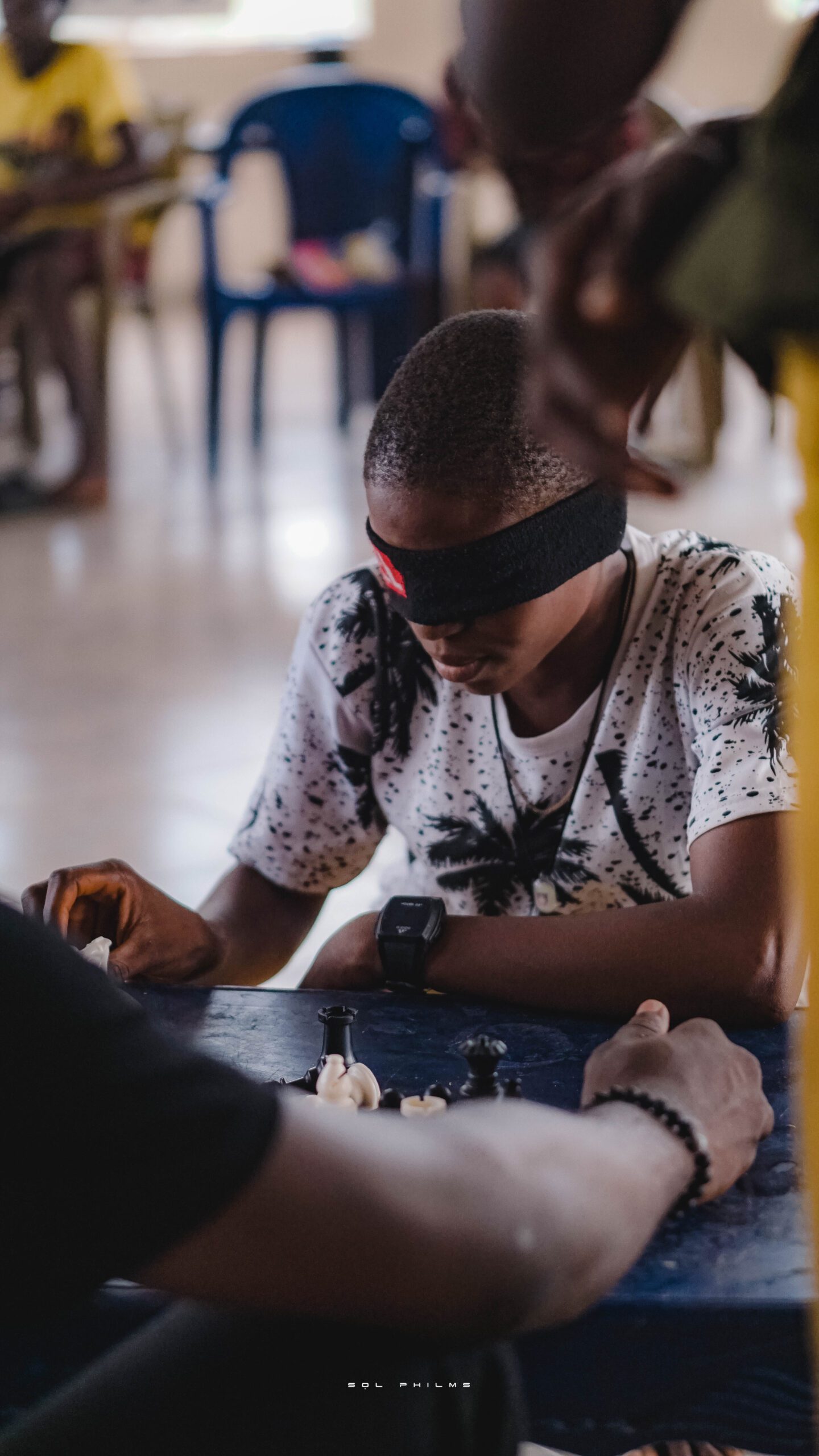



Every parent today is fighting the same quiet battle with the relentless pull of screens, phones, tablets, YouTube and games that never end. And the apps and platforms designed to entertain children are also, by design, doing the thinking for them.
The average child now spends over seven hours a day in front of a screen, and researchers are increasingly linking excessive screen time to weaker memory, shorter attention spans, and slower cognitive development.
But what if there was something your child could do that was just as engaging as a game, just as fun as screen time, and at the same time was actively building their brain?
Chess is exactly that.
Children who play chess have been shown to score up to 17% higher in mathematics and demonstrate stronger critical thinking than peers who don’t, but beyond the academics, chess teaches;
- children how to be patient,
- how to think before they act,
- how to make decisions under pressure,
- how to lose gracefully and come back stronger.
These are life skills your child can simply pick up by playing a game. It is not a trade-off between fun and learning. Chess delivers both at once. So the real question is not whether chess is worth it. The question is;
What age can my child learn chess?
…and the answer might surprise you.
What Age Should a Child Learn Chess?

The best age for a child to learn chess is typically between 6 and 7 years old, as pointed out by most chess coaches and child development experts. At this stage, children usually have developed the attention span, emotional maturity, and logical reasoning needed to learn and enjoy the game.
However, many children can begin learning chess as early as age 4 or 5 through fun, play-based activities that feel more like games than structured learning.
The world’s greatest players are useful reference points:
- Bobby Fischer learned the rules at age 6 and began playing seriously at 7.
- Magnus Carlsen, who later became World Champion, started at age 5 and played his first tournament at 8.
Neither became great because of rare genetic talent. They started early, stayed curious, and were given access to the game at the right time.
A key takeaway is this: ages 6 to 7 are not a strict rule. Structured learning does not have to begin there. Many children are ready much earlier, and evidence of early exposure goes beyond research papers.
It also shows up in real-life stories, like that of a five-year-old girl from Ikorodu who had never seen a chess piece before, and whose instinct to reach for one changed everything.
Basirat, the 5-year old girl from Majidun, Ikorodu
At Chess in Slums Africa [CISA], we are often asked: how early is too early? Our answer is always the same, and one of the clearest examples we can point to is a little girl named Basirat.

When our Founder, Tunde Onakoya, and the team visited the Majidun community in Ikorodu, Lagos, we came to introduce chess to children who had never encountered the game before.
Most had no access to school, no books, no structured learning of any kind. We arrived with the pieces, a mat, and one belief: that every child, regardless of where they were born, deserved a seat at the board.
That was the day we met Basirat. She was five years old and had no idea what chess was. But the moment Tunde arrived with the pieces, she tugged at his trousers and simply would not let go, not until he placed a chess piece in her hand. That single gesture of a five-year-old girl reaching for something she had never seen before, surprised all of us.
Today, Basirat is enrolled in one of the best Montessori schools in Ikorodu on a lifelong scholarship made possible through chess. As our founder always says:
In chess, a pawn can march all the way across the board and become a Queen

Basirat wasn’t ready because of her age. She was ready because of her curiosity.
And that is the truth every parent needs to hear: readiness often reveals itself when a child encounters something that genuinely excites them.
The challenge is not to force it, but to recognise and nurture that curiosity when it appears.
What Does Chess Look Like for a 4 or 5-Year-Old?
By age four, most children can already learn how each piece moves. They will need reminders, but with patience and gentle repetition it gradually becomes second nature, and it feels like play rather than study because at this age it should be exactly that.
At this age, chess should look like this:
- Mini-games and short activities instead of full matches
- Visual puzzles that build pattern recognition
- Stories and imagination woven around the pieces
- Short, low-pressure sessions
- No ratings, no competition, no tournaments, just play
- Freedom to hold and explore the pieces at their own pace
The goal at this stage is familiarity, joy, and planting seeds that will grow into something meaningful over time.
Is 10 or 12 Too Late to Learn Chess?
Absolutely not.
Starting later is not a disadvantage. In fact, older beginners often make faster early progress precisely because they come to the board with a more developed mind.
A child who starts at nine already has a longer attention span, absorbs complex rules quickly, and grasps strategy far sooner than a five-year-old would. What might take a younger child months to understand, an older child can pick up in a few focused sessions.
Children who begin chess at 10, 12, or even in their teens can still:
- Become competitive and accomplished players
- Progress steadily and with real satisfaction
- Develop genuine strategic depth and creativity
- Gain all the cognitive and life benefits chess provides
Success in chess comes down to the quality of coaching, consistency of practice, and how much they genuinely love the game. There is no such thing as starting too late.
What Can Children Learn at Different Ages?
| Age | What Children Typically Learn in Chess |
|---|---|
| 4–5 Years | Piece movement, mini-games, patterns and recognition |
| 6–7 Years | Full games, basic strategy, checkmate concepts |
| 8–10 Years | Tactical thinking, puzzles, competition |
| 11–16 Years | Advanced strategy, tournament preparation and analysis |
This progression shows why there is no single perfect age to start chess. Different ages simply require different teaching approaches
Read Also: Build Emotional Strength in Your Child Through Chess
How Do I Know My Child Is Ready to Learn Chess?
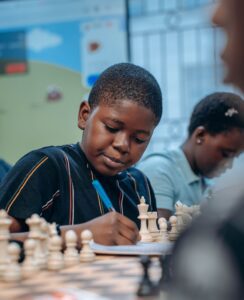
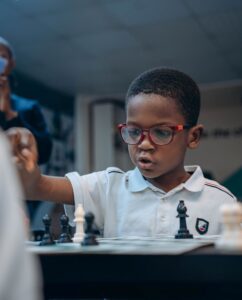
While age can be a helpful guide, readiness often matters more. Some children are eager to learn chess at five, while others may not be interested until they are eight or nine.
Here are a few signs your child may be ready to learn chess:
- Does your child enjoy puzzles?
- Do they like sitting with a problem until they find their way through it?
- Do they get absorbed in games that ask something of them mentally?
These are quiet indicators of a mind wired for chess, whether they have ever seen a board or not. The simplest test is to introduce them to it and watch what happens. A child who is ready will lean in, and a child who is not will let you know that too, which is equally fine.
For parents who want to explore the game at home, Chesskid.com, is an excellent starting point.
Where Can Children Learn Chess in Lagos?
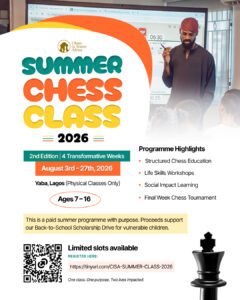 For parents searching for chess classes for kids in Lagos, physical learning environments often deliver the fastest and most consistent progress. Children benefit from structured lessons, experienced coaching, peer interaction, healthy competition, and regular guided practice.
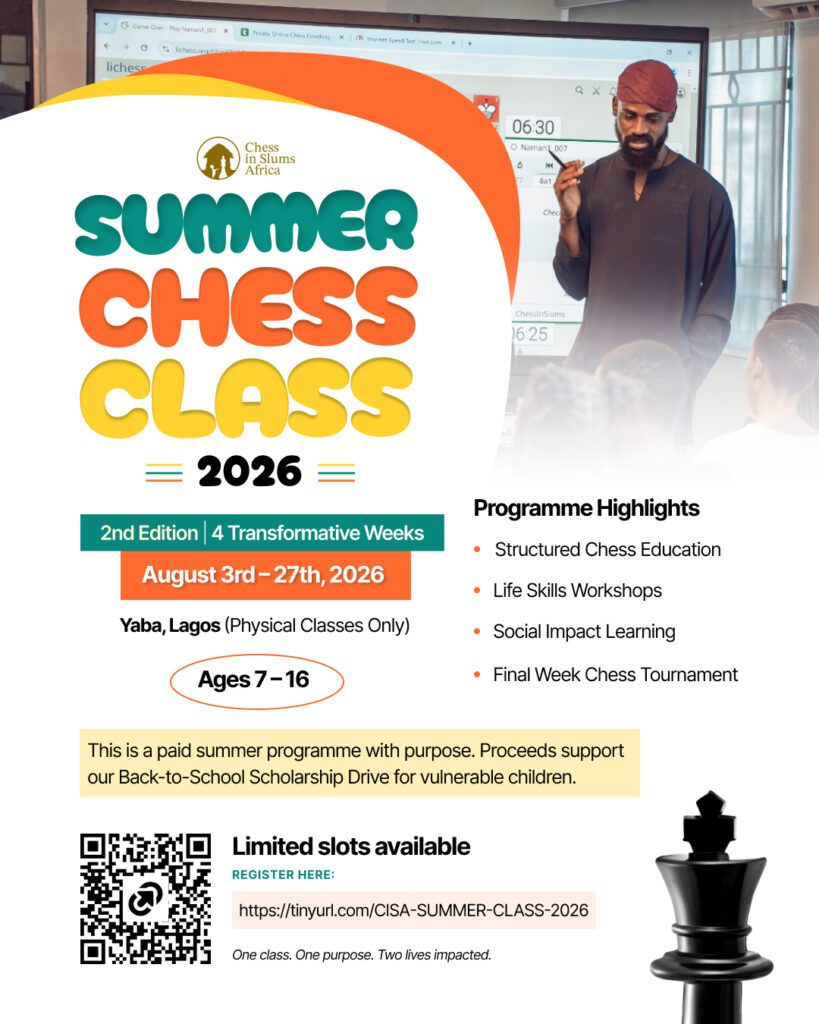
If you are looking for chess classes for kids in Lagos this August, we are hosting the 2nd Edition of our Summer Chess Classes, a four-week intensive programme designed for children aged 7 to 16.
Whether your child is a complete beginner or already understands the basics and wants to improve, the programme is designed to meet them at their level and help them grow with confidence and direction.
Give your child more than a holiday this summer. Give them strategy, confidence, and a sense of purpose that lasts long after the summer ends. Register your child today.
Contact us; hello@chessinslumsafrica.com
Frequently Asked Questions
What age should a child learn chess?
Most children are ready for structured chess learning between ages 6 and 7. However, many children can begin learning basic concepts as early as age 4 or 5.
Can a 4-year-old learn chess?
Yes. Four-year-olds can learn how pieces move, recognise patterns, and enjoy simple chess-based games through age-appropriate instruction.
Can a 5-year-old learn chess?
Absolutely. Many children begin learning chess successfully at age 5 through play-based activities, puzzles, and guided lessons.
Is chess good for child development?
Yes. Chess helps children develop concentration, patience, memory, problem-solving skills, critical thinking, and resilience.
Is 12 too old to start learning chess?
Not at all. Many children begin learning chess at 10, 12, or even later and still become strong, confident players.
Where can children learn chess in Lagos?
Children can learn chess through schools, clubs, private coaching programmes, and structured initiatives such as Chess in Slums Africa’s Kids Chess Summer Classes in Yaba, Lagos.